
Top 10 Types of Solar Street Lights for Global Buyers
Choosing a solar street light is not simply a matter of selecting the brightest lamp. Global buyers must compare sunlight, road conditions, maintenance access, battery performance, and local weather. A coastal road may demand corrosion-resistant aluminum. A snowy village may need a steeper solar panel angle. A busy urban lane may benefit from motion dimming and remote monitoring.
Thomas Edison, an early solar-energy advocate, reportedly said, “I’d put my money on the sun and solar energy. What a source of power!” His words remain relevant, although modern solar street lighting requires more than optimism. It requires tested photovoltaic panels, dependable lithium batteries, efficient LEDs, and careful photometric planning. A low-cost unit can look attractive on paper. Its battery may still fail after several cloudy nights.
This guide explores ten major types of solar street lights for international buyers. The list includes all-in-one models, split systems, integrated lights, smart-controlled units, hybrid solar-grid designs, and options for highways, parks, residential roads, and remote areas. Each type serves a different practical need. Some prioritize easy installation. Others deliver stronger illumination or longer autonomy.
Specifications can mislead.
A higher wattage does not always create better road visibility. Poor optics may waste light beyond the pavement. An oversized battery may increase weight, cost, and replacement difficulty. Buyers should examine lumen output, beam distribution, battery chemistry, panel efficiency, operating temperature, and warranty evidence. They should also request independent test reports when available. No single solar street light fits every country, road, or budget. That limitation deserves honest attention. Sustainable infrastructure improves when performance claims meet real nights, real weather, and real maintenance conditions.
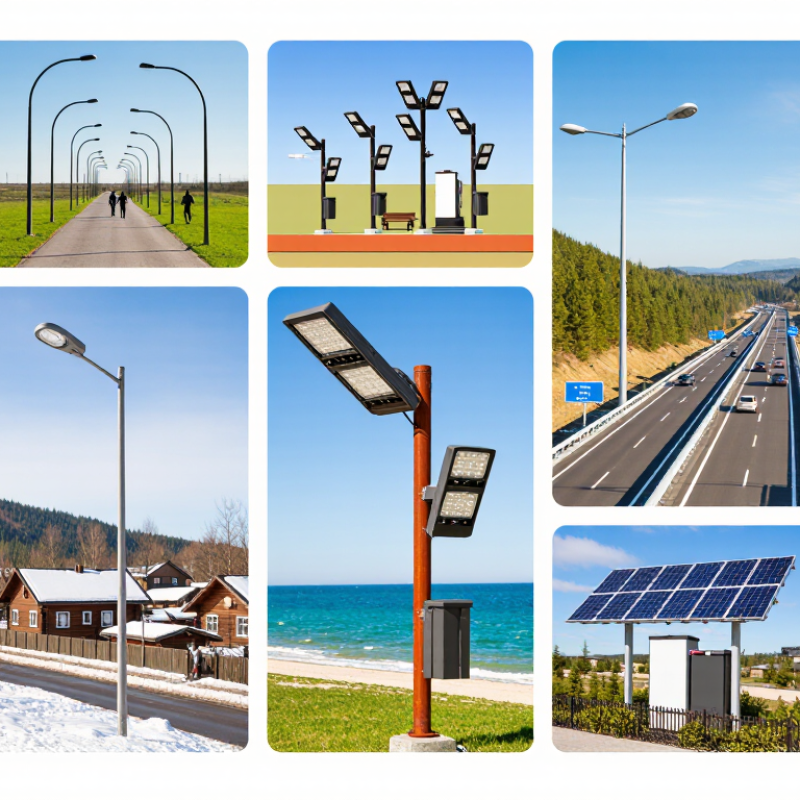
Solar Street-Light Taxonomy: 10 Types by Energy, Optics, and Mounting
Solar street lights are not one uniform product. Their taxonomy depends on energy supply, optical control, and mounting structure. The first type is the standalone photovoltaic light, using a panel and battery for off-grid roads. The second is a grid-assisted solar light, which switches to utility power during long cloudy periods. The third is a solar-wind hybrid light, suitable for exposed coastal or highland sites. Performance can vary sharply with local weather.
The fourth type uses fixed-angle LED optics for predictable road lanes. The fifth adds adaptive dimming, reducing output after midnight when traffic declines. The sixth uses asymmetric optics, directing light across the carriageway instead of wasting it behind the pole. The seventh provides wide-area illumination for plazas, crossings, and open paths. Optics matter. A bright lamp can still create dark pavement.
The eighth type is an all-in-one pole-top unit, with the panel, battery, and lamp in one housing. The ninth is a split solar light, placing the panel above the fixture for better tilt adjustment. The tenth is a wall-mounted solar light, useful for alleys, compounds, and pedestrian entrances. Installation experience shows that mounting height, tree shadows, battery access, and drainage often decide reliability. The categories overlap, and that is worth admitting. A compact all-in-one unit may simplify installation but limit battery replacement. A split system may perform better, yet require stronger wiring protection and more maintenance planning.
Top 10 Types of Solar Street Lights for Global Buyers - Solar Street-Light Taxonomy: 10 Types by Energy, Optics, and Mounting
| Rank | Solar Street-Light Type | Energy Architecture | Typical Battery Configuration | Optical Design | Mounting and Form Factor | Typical Applications | Main Advantages | Key Buyer Considerations |
|---|---|---|---|---|---|---|---|---|
| 1 | All-in-One Solar Street Light | PV panelLED lampBatteryController integrated | Usually lithium-ion or lithium iron phosphate battery housed inside the luminaire body | Fixed asymmetric road optic; commonly uses LED lenses designed for roadway distribution | Single compact luminaire mounted on a straight or curved pole arm | Residential roads, parks, pathways, small streets and decentralized projects | Fast installation, compact appearance, fewer external cables and components | Thermal management, battery replacement access, shading, wind load and controller quality |
| 2 | Split-Type Solar Street Light | Separate PV moduleSeparate LED headExternal controller | Battery installed in a dedicated enclosure, pole compartment or underground cabinet | Roadway, pathway or area-lighting optics selected independently of the PV module | PV panel mounted above or beside the luminaire; battery and controller positioned separately | Flexible component sizing, easier servicing and better separation of heat sources | Requires more cabling, stronger installation planning and protection against moisture ingress | |
| 3 | All-in-Two Solar Street Light | Lamp and battery integratedPV module separate | Battery enclosed in the lamp housing, commonly using lithium iron phosphate chemistry | Asymmetric roadway optics with adjustable or fixed light distribution | Integrated lamp-battery unit on the pole arm; separate PV panel mounted at an optimized tilt | Urban roads, village streets, parking areas and projects needing improved solar orientation | Balances compact installation with better PV positioning and heat separation | Check cable protection, connector reliability, battery service access and pole compatibility |
| 4 | AC-DC Hybrid Solar Street Light | Solar energyGrid backupAutomatic switching | Rechargeable battery sized for solar autonomy; grid power supports low-sun periods or backup operation | Roadway or area-lighting optics depending on pole spacing and illumination requirements | Solar luminaire connected to both a PV-battery system and an AC supply circuit | Urban streets, public facilities and locations requiring high lighting availability | Improves operational continuity during extended cloudy periods | Needs compliant electrical protection, grid-interface design and clear backup control logic |
| 5 | Off-Grid Stand-Alone Solar Street Light | 100% solar supplyNo utility connection | Battery bank sized according to local solar resource, operating hours and required autonomy | Usually asymmetric road optics or wide beam optics for open areas | Independent PV panel, luminaire, controller, battery enclosure and pole assembly | Remote roads, rural routes, construction areas and locations without reliable grid access | Operates independently of utility infrastructure and avoids trenching for power cables | Correct sizing is essential; consider winter irradiance, consecutive cloudy days and maintenance access |
| 6 | PIR Motion-Sensing Solar Street Light | Solar-poweredDimming controlPassive infrared sensor | Battery capacity can be reduced when low-power standby operation is acceptable | Focused roadway or pathway optic, often combined with a wider low-level standby distribution | Integrated or split luminaire with PIR sensor mounted toward the approach zone | Residential lanes, walkways, parking areas and low-traffic security lighting | Reduces overnight energy consumption and can extend lighting duration during poor weather | Sensor range, detection angle, false triggering, response time and local temperature effects |
| 7 | Remote-Controlled Smart Solar Street Light | Solar-battery systemWireless monitoringProgrammable dimming | Battery bank managed by a charge controller with status reporting and fault monitoring | Photometric roadway optic selected according to road width, pole height and spacing | Standalone or split configuration with a control unit and wireless communication module | Municipal roads, campuses, industrial parks and distributed infrastructure networks | Remote scheduling, fault alerts, performance tracking and adaptive lighting control | Communication coverage, cybersecurity, software compatibility, data costs and long-term support |
| 8 | Vertical-PV Solar Street Light | Vertically mounted PVSolar-battery supply | Battery capacity selected for the reduced or variable solar collection profile | Roadway optic positioned independently from the vertical PV surfaces | One or more narrow PV panels mounted vertically on the pole or a dedicated side frame | Snow-prone areas, narrow roads, high-wind locations and sites with limited horizontal space | Lower risk of snow accumulation and a compact footprint in constrained installations | Annual solar yield, orientation, shading, rear-side access and local wind loading must be assessed |
| 9 | Dual-Arm Solar Street Light | Shared PV systemOne or two LED heads | Central battery system or integrated batteries sized for both lighting heads | Two asymmetric roadway distributions aimed in opposite directions | Two luminaires mounted on opposite arms from one pole, with a shared PV assembly | Wide roads, medians, intersections, roundabouts and divided carriageways | Can illuminate two directions from one foundation and pole location | Higher structural load, larger energy requirement, glare control and careful aiming are important |
| 10 | Solar Floodlight-Style Street and Area Light | Solar-battery supplyHigh-area coverage | Battery bank sized for broad-area illumination and the desired nightly operating profile | Symmetric or rectangular flood distribution rather than a narrow roadway pattern | Adjustable floodlight mounted on a pole, wall, bracket or dedicated support structure | Public squares, parking lots, courtyards, bus stops, entrances and open recreational areas | Flexible aiming and broad coverage for irregular spaces | May create glare or uneven illumination if aimed incorrectly; verify uniformity and spill-light limits |
Related Posts
-

How to Choose the Best Solar Street Lamp in 2026?
-
Top 10 Solar Powered Street Lights for Global Buyers
-
What Is an All in One Solar Street Light?
-
How to Choose Solar Powered Street Lights for Any Project?
-
10 Best Solar Street Lights for Eco-Friendly Lighting Solutions in 2023
-

What are the Benefits of Solar Street Lights for Cities?