
Top 10 Solar Lamp Post Suppliers for Global Buyers
Solar lamp post purchasing is becoming more strategic as renewable power expands worldwide. IRENA’s Renewable Capacity Statistics 2024 reports that global renewable capacity increased by 473 GW in 2023. Solar power contributed approximately 346 GW, representing nearly three quarters of new renewable capacity. This momentum supports wider interest in independent outdoor lighting for streets, campuses, parks, resorts, and remote facilities.
Yet growth does not guarantee a reliable product. A lamp post must survive heat, rain, dust, wind, and repeated battery cycles. The International Energy Agency’s Renewables 2024 analysis highlights solar PV’s continuing cost and deployment advantages, but local conditions still determine performance. Shading, winter sunlight, soil stability, and maintenance access can change the purchasing decision completely.
This guide introduces the Top 10 Solar Lamp Post Suppliers for Global Buyers. It focuses on manufacturing experience, photovoltaic and battery specifications, lighting performance, certifications, warranties, customization, and export capability. The U.S. Department of Energy notes that LED lighting can deliver substantial energy savings compared with conventional technologies, although actual results depend on system design and operating hours.
The comparison is practical, not absolute. Supplier rankings can shift with project size, regional compliance, and after-sales support. Some impressive product pages also reveal limited test data. That deserves attention. Buyers should request LM-79 or equivalent photometric evidence, battery cycle information, IP and IK ratings, wind-load calculations, and sample testing before signing large contracts. A bright specification sheet is not enough. Reliable lighting is measured after many dark nights.
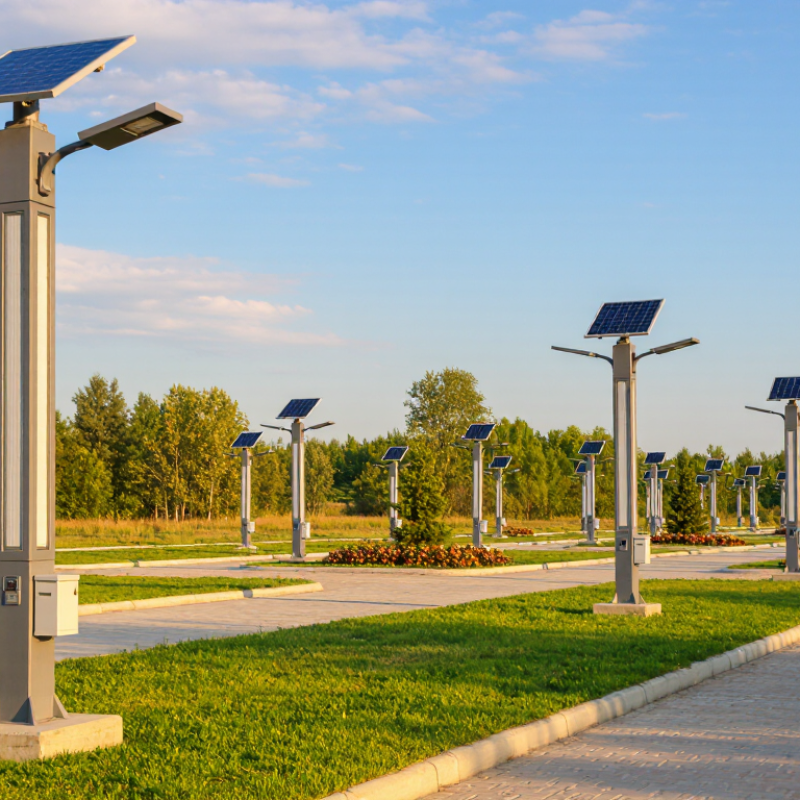
Solar Lamp Post Suppliers: Industry Scope and Product Categories
Solar Lamp Post Suppliers: Industry Scope and Product Categories
The solar lamp post industry serves streets, gardens, campuses, parks, and commercial entrances. Global buyers usually compare suppliers by design flexibility, production capacity, testing records, and after-sales support. A reliable supplier should explain lighting performance under local weather conditions. Rainfall, temperature, sunlight hours, and dust can change system results.
Product categories cover decorative garden posts, roadway lamps, pathway lights, parking-area systems, and smart solar poles. Common configurations include all-in-one units, split systems, and integrated battery designs. Buyers should review LED wattage, lumen output, battery chemistry, panel efficiency, pole height, and lighting duration. Ask for IP ratings and documented test results. Ask for real project data.
Quality is not only a catalog issue. Suppliers need stable component sourcing, clear installation guidance, and practical warranty terms. Some provide remote monitoring, motion sensors, dimming controls, or customized colors. Others focus on standard models for faster delivery and easier replacement. The cheapest option may hide weak batteries or unclear performance claims. That risk deserves attention.
Field experience also reveals a limitation. Rated lighting hours may assume ideal sunlight and clean panels. Dust, shade, and winter conditions can reduce output. Buyers should request simulation data for the target location and test samples before large orders. Supplier rankings often favor visibility, but technical transparency matters more. Good decisions require evidence, not attractive photographs.
Top 10 Solar Lamp Post Suppliers for Global Buyers - Solar Lamp Post Suppliers: Industry Scope and Product Categories
| No. | Supplier Product Category | Typical Global Applications | Common Solar Configuration | Typical Lighting and Power Range | Battery Options | Common Protection Rating | Key Buyer Considerations |
|---|---|---|---|---|---|---|---|
| 1 | All-in-One Solar Lamp Posts | Residential streets, pathways, parks, campuses and small public areas | LED luminaire, photovoltaic panel, battery and controller integrated into one housing | Usually 20–80 W LED; commonly selected for moderate pedestrian and roadway illumination | Lithium-ion or lithium iron phosphate batteries are commonly specified | Typically IP65 or higher for the luminaire and enclosure | Compact installation, simplified wiring, battery replacement access and thermal management |
| 2 | Split-Type Solar Lamp Posts | Urban roads, highways, industrial parks and large outdoor sites | Separate solar panel, LED light, battery box and charge controller | Commonly 30–150 W LED, depending on pole spacing and required road classification | Lithium iron phosphate or lead-acid systems may be offered according to project budget and climate | Usually IP65–IP67 for outdoor components | Flexible panel orientation, easier component upgrades and suitability for higher loads |
| 3 | Integrated Smart Solar Lamp Posts | Smart-city corridors, municipal streets, transport hubs and managed campuses | Solar lighting combined with motion sensors, remote monitoring or adaptive dimming | Often 20–100 W LED with programmable dimming profiles | Rechargeable lithium-based batteries with battery-management protection | Typically IP65 or higher; surge protection is commonly requested | 通信协议, cloud access, cybersecurity, data ownership and maintenance fees should be evaluated |
| 4 | Solar Street Lamp Posts with Motion Control | Low-traffic roads, residential communities, trails and rural access routes | LED output reduced during low activity and increased when motion is detected | Commonly 15–60 W LED with programmable standby and boost levels | Lithium-based batteries are widely used because of cycle life and lower maintenance | Usually IP65–IP66 for the lamp and sensor assembly | Sensor detection range, false-trigger resistance, battery autonomy and local wildlife conditions |
| 5 | Decorative Solar Garden and Park Lamp Posts | Gardens, resorts, pedestrian plazas, heritage areas and recreational parks | Decorative pole, solar module, low-power LED source and concealed battery compartment | Commonly 3–30 W LED; warm-white output is frequently selected for visual comfort | Lithium-based cells or rechargeable nickel-metal hydride batteries for smaller units | Typically IP44–IP65, depending on enclosure and installation exposure | Aesthetic finish, corrosion resistance, glare control, foundation design and replaceable parts |
| 6 | High-Lumen Solar Roadway Lamp Posts | Arterial roads, intersections, logistics areas and wide public corridors | Large photovoltaic array, high-capacity battery bank and roadway-optimized LED optics | Often above 100 W LED and engineered for larger pole spacing or higher mounting heights | High-capacity lithium iron phosphate systems are commonly considered for intensive operation | Typically IP66 or higher, with additional surge and over-temperature protection | Photometric studies, wind loading, autonomy during cloudy periods and battery replacement logistics |
| 7 | Hybrid Solar and Grid-Connected Lamp Posts | Urban projects requiring high reliability, commercial sites and critical access roads | Solar generation supplemented by grid power when battery charge is insufficient | Commonly 30–150 W LED, with automatic source switching | Rechargeable lithium or lead-acid batteries, depending on system architecture | Typically IP65–IP66 for outdoor equipment | Grid safety, transfer controls, electrical certification, energy metering and local regulations |
| 8 | Solar Lamp Posts for Remote and Off-Grid Areas | Rural roads, villages, emergency routes, humanitarian projects and remote facilities | Fully autonomous photovoltaic system with programmable energy-saving operation | Usually 10–60 W LED, selected according to local solar resource and lighting need | Long-life lithium iron phosphate batteries are widely preferred for low-maintenance deployment | Typically IP65 or higher, with dust and corrosion protection where required | Solar-resource assessment, multi-night autonomy, theft prevention and local service capability |
| 9 | Solar Lamp Posts with CCTV or Public-Safety Integration | Parking areas, transport facilities, public spaces and perimeter security zones | Solar lighting with optional camera, emergency call, loudspeaker or communication equipment | Lighting commonly ranges from 30–100 W LED, subject to the auxiliary equipment load | Higher-capacity lithium battery systems with dedicated power management | Typically IP66 for outdoor equipment; vandal-resistant construction may be specified | Total energy budget, network coverage, storage capacity, privacy requirements and pole stability |
| 10 | Custom-Engineered Solar Lamp Post Systems | Large municipal tenders, coastal areas, cold climates and specialized infrastructure | Project-specific combination of panel size, battery capacity, optics, controls and pole structure | Power, mounting height and illumination distribution are calculated from the project brief | Battery chemistry and capacity selected according to temperature, autonomy and lifecycle requirements | Often IP66 or higher for demanding outdoor environments | Wind-load calculations, corrosion class, local electrical codes, photometric compliance and after-sales support |
Related Posts
-

Top 10 Solar Lamps for Outdoor Lighting: Brighten Your Nights Effortlessly
-

What is a solar street lamp and how does it work?
-

How to Choose the Best Solar Lamp Post for Your Outdoor Space?
-
Best Solar Lamp Post Options for Global Buyers?
-
China Best Solar Lamp Options for Global Buyers in 2026?
-

How to Choose the Best Solar Street Lamp in 2026?