Who Are China Top Hydraulic Piling Rig Manufacturers?

China’s Hydraulic Piling Rig manufacturers compete in a market shaped by infrastructure demand, ground conditions, and project budgets. The need is tangible: deep foundations support bridges, ports, railways, and high-rise buildings. The equipment must deliver steady torque and controlled penetration, even when soil layers change beneath the tracks.

Industry reports offer useful context. Oxford Economics and Global Construction Perspectives projected that global construction output would grow by 85% between 2015 and 2030. China’s National Bureau of Statistics reported a 5.9% increase in infrastructure investment in 2023. These figures do not measure piling rig sales directly. They do, however, help explain why buyers compare manufacturers on more than price. Reliability matters. So do service access, parts availability, and clear technical documentation.

Geotechnical engineer Professor Harry Poulos’s published work on pile foundations offers a practical lens: pile selection and performance must be assessed against soil conditions and design loads. That principle also helps frame this manufacturer review. We will examine Chinese suppliers through product range, engineering capability, manufacturing quality, and after-sales support. Specifications can look impressive on paper. Field performance is harder to judge, and available information is not always comparable. The comparison is not perfectly tidy. Buyers should verify machine configurations and support terms directly before making a decision.
Who Are China Top Hydraulic Piling Rig Manufacturers?

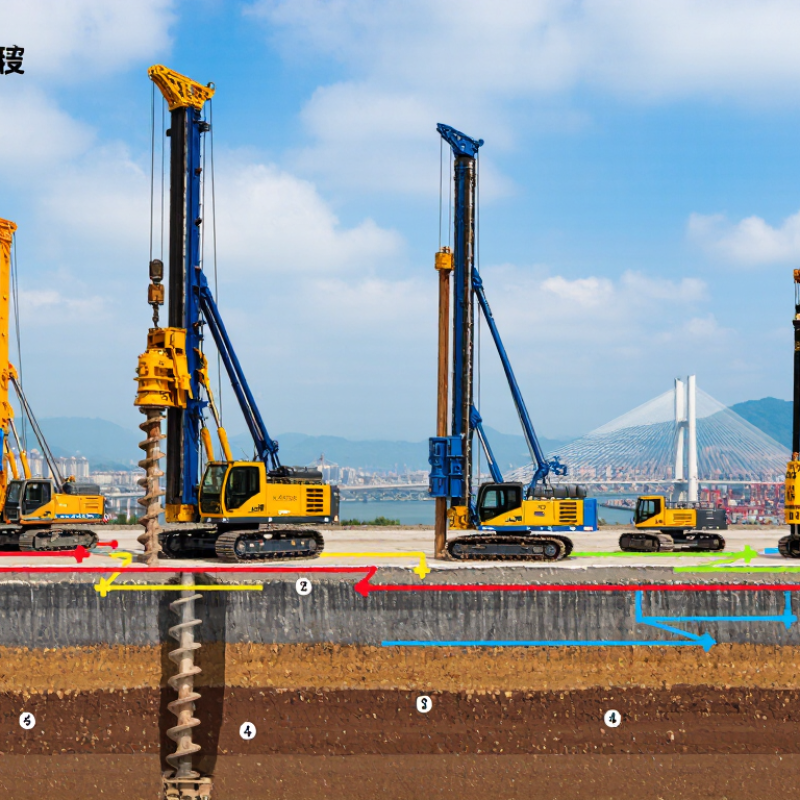
Hydraulic Piling Rigs: Rotary Drilling, Static Press-In, and Impact Types

Who Are China Top Hydraulic Piling Rig Manufacturers?
Hydraulic Piling Rigs: Rotary Drilling, Static Press-In, and Impact Types

China’s leading hydraulic piling-rig manufacturers are best assessed by matching machine design to site conditions, not by headline capacity alone. Rotary drilling rigs bore through soil or rock with a rotating tool, producing spoil that must be managed. They suit varied strata, though hard inclusions can slow progress. Static press-in rigs push piles into the ground using reaction force from installed piles. They are useful near sensitive buildings because they avoid hammer blows, but need a stable reaction system and careful sequencing. Ground conditions matter.

Impact rigs drive piles with repeated hammer strikes. They can deliver strong production rates, but noise and vibration need attention near occupied sites. FHWA’s Roadway Construction Noise Model lists an impact pile driver at about 101 dBA Lmax at 50 feet; actual readings depend on equipment and surroundings. Noise travels. China’s National Bureau of Statistics reported construction output value of RMB 31.59 trillion in 2023, underscoring the scale of projects where piling choices matter. Buyers should compare verified output, pile diameter and depth ranges, ground-adaptation features, service response, and test records. One detail is often missed: a powerful rig may still be a poor fit when access is tight or spoil disposal is limited. That trade-off deserves a site-specific review.

Major Chinese Manufacturers: SANY, XCMG, Zoomlion, Sunward, and TYSIM

China’s leading hydraulic piling rig manufacturers include large construction-equipment groups and companies focused on foundation machinery. Their product ranges can differ widely. Some offer rigs alongside cranes, excavators, and other heavy equipment, while specialist producers may concentrate more closely on piling applications. Compare models by rated torque, maximum drilling depth, mast configuration, and carrier stability—not by headline capacity alone.

On site, details matter. A rig’s transport width can affect access to a cramped urban project, while its working weight influences ground preparation. Ask for the operating manual, maintenance intervals, and clear service-response terms. Check whether the stated performance reflects your soil conditions and tooling; catalog figures may assume an ideal setup. A machine suited to bored piles in firm ground may not fit every casing method or site layout. Parts availability also deserves attention, especially for hydraulic pumps, hoses, and filters. This comparison is rarely neat. Local support and operator training can matter as much as the machine’s published specifications.

Who Are China’s Top Hydraulic Piling Rig Manufacturers?

Unbranded overview of common hydraulic piling equipment categories and representative capabilities.

Equipment Category Common Piling Method Representative Capability Range Typical Applications Key Selection Considerations
Hydraulic rotary drilling rig Rotary drilling with buckets, augers, or core barrels Common project configurations: approximately 100–400 kN·m torque; 1.5–3.0 m drilling diameter; 40–100 m drilling depth Cast-in-place bored piles for buildings, bridges, and transport infrastructure Required pile diameter and depth, ground conditions, torque, crowd force, and site access
Hydraulic static pile driver Presses precast piles into the ground using static force Common press-in force classes are approximately 6,000–12,000 kN; available capacity varies by configuration Urban foundations and projects where low noise and reduced vibration are important Pile type and size, required press-in force, reaction system, working platform, and ground resistance
Hydraulic impact piling rig Drives piles using repeated hammer blows Hydraulic hammer impact energy commonly ranges from tens to over 100 kJ, depending on hammer and pile requirements Driven pile foundations for buildings, ports, bridges, and marine works Pile material, required penetration, permissible noise and vibration, and hammer energy
Continuous flight auger (CFA) rig Drills with a continuous-flight auger and places concrete as the auger is withdrawn Typical project piles are approximately 0.4–1.2 m in diameter and 20–35 m deep Foundations in soft or water-bearing soils where continuous concreting is suitable Soil profile, pile diameter and depth, concrete delivery rate, and spoil handling
Hydraulic diaphragm wall grab Excavates deep wall panels under stabilizing slurry Common panel widths are approximately 0.6–1.5 m; project depths often range from 30–60 m Basement retaining walls, underground stations, and deep excavation support Wall depth and thickness, geology, slurry management, verticality control, and site constraints

Ranges are indicative industry examples, not specifications for any particular manufacturer or model. Actual performance depends on equipment configuration, tooling, soil or rock conditions, and project requirements.

Typical Rotary-Rig Benchmarks: 100–400 kN·m Torque and 1–3 m Pile Diameter

For buyers comparing China’s hydraulic piling rig manufacturers, torque and pile diameter are useful starting points. Typical rotary rigs span roughly 100–400 kN·m of torque and handle piles about 1–3 m in diameter. These ranges describe common benchmarks, not a guarantee that every machine can drill every pile. Soil layers, tool choice, and operating method all affect performance.

Check what the torque figure actually represents. A peak rating may differ from torque available during continuous drilling. Ask for the rated duty cycle, crowd force, mast configuration, and compatible drilling tools. On site, a 250 kN·m rig in dense gravel may behave very differently from the same rig in softer ground. Details matter.

Diameter alone can mislead. A 3 m pile requires suitable stability, tooling, and lifting capacity, not just enough torque. Review project soil reports and compare them with documented test conditions. Request service records and commissioning data where available. A benchmark is not a promise. I’d also leave room for uncertainty: published figures rarely capture every site condition, so verify the machine against the actual pile design before selecting it.

These ranges summarize the typical rotary-rig benchmarks in the title. They are broad reference ranges, not specifications for any particular manufacturer or machine.

How Power, Maximum Drilling Depth, and Ground Conditions Affect Rig Selection

Who Are China Top Hydraulic Piling Rig Manufacturers?

When comparing China’s hydraulic piling rig manufacturers, start with the job, not the brochure. Rated power matters, but usable torque and hydraulic flow affect how steadily a rig handles dense layers. A powerful machine can still struggle if its tool, pile diameter, and soil resistance are poorly matched. Maximum drilling depth needs context, too. Ask what mast, drilling tool, and ground profile were used to determine the stated figure. Extra reach can mean more transport and setup demands. A real trade-off.

Ground conditions shape the choice. Loose sand, stiff clay, and gravel place different demands on the rig and drilling tools. On site, a sudden change from soft soil to cobbles can slow progress and increase wear. Review local soil reports, then ask manufacturers for operating data from comparable projects. Check the rig’s working torque, hydraulic stability, and support for suitable tools. Specs alone cannot predict every site. That is easy to overlook.

Tips: Match the rig to the toughest expected layer, not just average conditions. Confirm depth with the intended tooling, and ask how the manufacturer handles field adjustments. A short site trial can reveal issues a chart misses.

How to Compare Manufacturers by Safety Standards, Parts, and Service Coverage

When comparing China’s hydraulic piling rig manufacturers, look beyond rated torque and drilling depth. Safety provisions should be documented and demonstrated on the machine. Check emergency stops, guarded pinch points, mast-lock indicators, and clear load charts. Ask how operators are trained to inspect hoses and hydraulic connections before each shift. A polished brochure is not proof. Request manuals and inspection records.

Parts availability affects downtime just as much as machine performance. Ask which wear parts are kept in stock, how quickly they can be dispatched, and whether part numbers are clearly listed. Get realistic lead times for filters, seals, and commonly replaced hose fittings. Ask for a sample parts list. Vague promises are hard to plan around.

Service coverage needs specifics. Find out which regions technicians can reach, what remote troubleshooting includes, and how response times are measured. A phone number alone is not a service plan. Ask whether technicians can support commissioning and operator training at your site. Compare written commitments, not only sales presentations. One easy mistake is treating a wide service map as proof of fast support; travel distance, parts access, and local technical skills still matter. Manufacturers should answer these questions plainly, though no checklist can predict every site condition.

Go to Top