Top Graphite Raw Material Suppliers for Global Buyers

Graphite Raw Material has become a strategic purchasing concern as battery, steel, and industrial markets compete for reliable supply. The U.S. Geological Survey’s Mineral Commodity Summaries 2025 estimates global natural graphite mine production reached about 1.6 million metric tons in 2024. China accounted for roughly 1.27 million tons. That concentration matters. The International Energy Agency’s Global Critical Minerals Outlook 2024 also highlights supply-chain concentration and diversification as important challenges for energy-transition minerals.

For buyers, a supplier’s name is only a starting point. A useful comparison examines product grade, flake size, carbon content, impurities, processing route, and consistency between shipments. Request current specifications and a representative certificate of analysis. Check whether the supplier can explain its sourcing and provide realistic lead times. A neat product sheet is not proof of stable quality. There is a catch: published capacity may differ from material available for export, and specifications can vary by deposit or processing method.

This guide introduces suppliers serving global buyers and the practical questions worth asking before procurement. It does not treat every producer as interchangeable. Instead, it focuses on verifiable product information, supply capability, and fit for the intended application. The right choice depends on the buyer’s technical requirements, not simply the lowest quoted price. Less obvious, but important. Even experienced buyers should verify details directly, since markets and available grades change.
Top Graphite Raw Material Suppliers for Global Buyers

Graphite Raw Materials: Types, Grades, and Key Uses

Graphite raw materials differ in origin, structure, particle size, and carbon content. Natural graphite includes flake, amorphous, and vein forms, each suited to different processing needs. Flake graphite is commonly assessed by flake size and fixed-carbon content. Fine flakes may suit some industrial blends, while larger flakes can be preferred for products that need expanded structure. Amorphous graphite is typically finer and is used in applications such as refractories and foundry materials. Small details matter.

Synthetic graphite is produced from carbon-rich feedstocks through high-temperature processing. Its consistency can make it useful in battery anodes, electrical components, and specialty applications. Buyers should compare purity, ash, moisture, particle-size distribution, and bulk density rather than relying on a grade name alone. Test methods and specifications can vary between suppliers, so matching figures across datasheets is not always straightforward.

End use should guide material selection. Refractory producers often focus on carbon content, oxidation behavior, and particle sizing. Foundries may prioritize consistent performance in their chosen formulation, while lubricant makers consider structure and dispersibility. Battery applications require tighter control of impurities and particle characteristics. A sample tested in the buyer’s own process can reveal issues that a specification sheet misses. It takes time, but can prevent an expensive mismatch.

Graphite Raw Materials: Typical Carbon Content by Type

Natural graphite grades vary with deposit and processing, while synthetic graphite purity depends on its production route. These broad indicative ranges are for comparison only; confirm specifications with the supplier for each product and application.

Global Graphite Supply: Major Producing Regions and Trade Flows

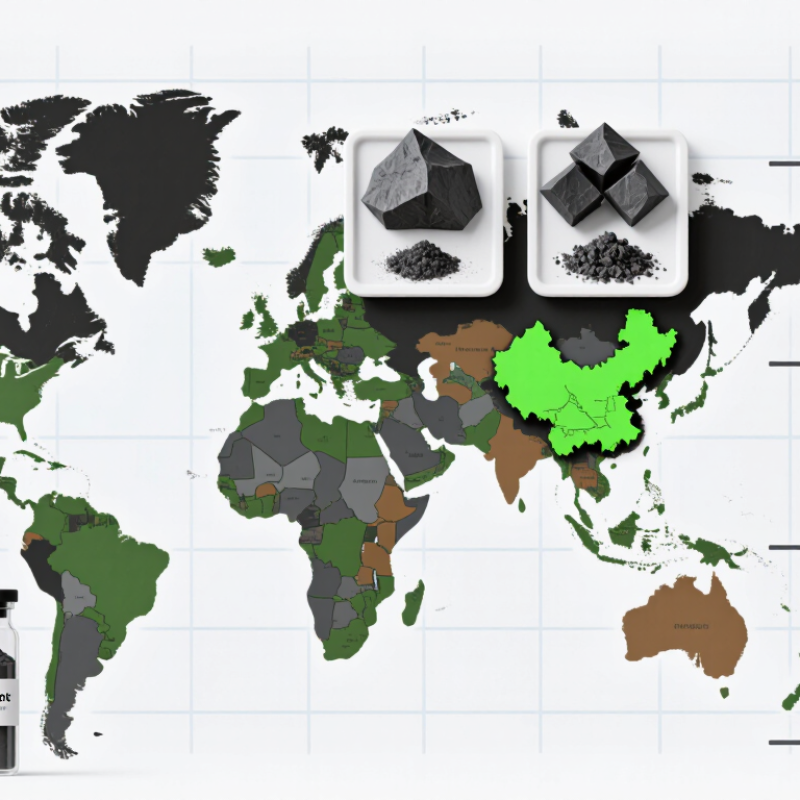
Graphite supply is geographically uneven. China remains the largest source of natural graphite and a major center for processing, while Brazil, Mozambique, Madagascar, and Canada contribute mined material. Output varies by deposit, grade, and investment, so country-level figures do not tell buyers everything. A shipment of flake graphite may need screening, purification, or further processing before it suits a particular application.

Trade flows often connect mines in producing regions with processors and manufacturers elsewhere. Concentrate may move by truck to a port, then travel in bulk bags or containers to industrial customers. Processing capacity is concentrated in a smaller number of markets than mining, which can create supply-chain bottlenecks. Trade data can mislead. Product categories may group different graphite forms together, and reported exports do not always reveal final destination or quality. Buyers can compare origin, particle-size specifications, carbon content, and delivery records rather than relying on a country label alone. This map is useful, but not complete. Port delays, changing freight rates, and limited public data can make a dependable supply picture difficult to maintain. A careful sourcing review should check both the mine’s output and the route the material takes to reach the buyer.

How to Identify and Evaluate Graphite Suppliers

Top Graphite Raw Material Suppliers for Global Buyers

How to Identify and Evaluate Graphite Suppliers

A supplier’s quoted grade is only a starting point. Ask for recent batch certificates showing fixed carbon, ash, moisture, sulfur, and particle-size distribution. Then compare those figures with an independent laboratory test on a representative sample. Small details matter. A bag marked “high purity” tells you little without test methods and tolerances. Check whether the supplier can keep specifications stable across shipments, not just produce one convincing sample.

Supply concentration deserves equal attention. The USGS Mineral Commodity Summaries 2025 estimates global natural graphite mine output at 1.6 million metric tons in 2024, including 1.27 million from China. The International Energy Agency’s Global Critical Minerals Outlook 2024 also highlights China’s dominant role in graphite refining. For buyers, this makes origin, processing location, and backup supply worth verifying. Request mine-to-shipment traceability, production capacity, lead times, and evidence of quality controls. A video call can help, but it is not an audit. Visit the facility or use a qualified third-party assessor when the purchase is substantial. Even careful checks have limits; test results can vary between laboratories, so agree on sampling and dispute procedures before placing a large order.

Purchasing Graphite: Specifications, Pricing, and Logistics

Top Graphite Raw Material Suppliers for Global Buyers

Purchasing Graphite: Specifications, Pricing, and Logistics

A reliable purchase starts with a written specification, not a broad label such as “high grade.” Define fixed carbon, ash, moisture, sulfur, and particle-size distribution. For battery applications, buyers may also request tap density and impurity limits. The USGS Mineral Commodity Summaries 2024 estimated global natural graphite mine production at 1.6 million metric tons in 2023, with China producing about 1.23 million. This concentration makes origin and supply continuity important purchasing details.

Ask suppliers for recent test results and a representative sample. Compare quotations on the same basis: grade, packaging, delivery terms, and payment schedule. Prices can differ sharply by flake size, purity, processing, and freight; a low price may hide extra screening or transport costs. The International Energy Agency’s Global Critical Minerals Outlook 2024 also highlights graphite’s growing role in clean-energy supply chains. Check whether quoted prices are fixed or indexed, and confirm how exchange rates and surcharges are handled.

Tips: Request a certificate of analysis for each lot, then verify key values independently when the order is large. Specify moisture-proof inner liners and pallet details, and confirm container loading limits before booking. Small detail. It matters. I have seen otherwise sound orders delayed because the packing instructions were vague. Keep the inspection window and claims process clear in the purchase contract.

Top Graphite Raw Material Suppliers for Global Buyers — Purchasing Graphite: Specifications, Pricing, and Logistics

Supplier categories and product specifications below are general purchasing references, not company rankings or guaranteed offers. Exact specifications, availability, and prices depend on origin, processing route, order volume, and contract terms.

Supplier / Product Category Typical Specifications to Request Common Sourcing Regions Pricing Considerations Logistics and Buyer Checks
Natural flake graphite concentrate Fixed carbon commonly around 94–97%; flake size quoted by sieve fractions, such as mesh size or micron range. Request moisture, ash, sulfur, and size-distribution limits. China, Mozambique, Madagascar, Brazil, and Canada are established sources of natural flake graphite. Usually quoted per metric tonne. Price varies with fixed-carbon content, flake size, origin, packaging, order volume, and whether the term is FOB or CIF. Often shipped in bulk or lined bags in containers. Confirm particle-size preservation, moisture protection, packaging weight, and inspection arrangements before shipment.
High-carbon flake graphite Typically upgraded to approximately 97–99% fixed carbon; confirm the precise carbon basis and limits for ash, sulfur, moisture, and oversized or undersized particles. Produced from natural flake concentrate in several graphite-producing and processing regions, including China, Madagascar, Brazil, and Canada. Generally priced above comparable lower-carbon concentrate. Processing level, flake-size distribution, and impurity limits have a material effect on the offer. Request a recent certificate of analysis for the specific lot. Check that the contract defines test methods and tolerances for each specification.
Amorphous (microcrystalline) graphite Carbon content varies by deposit and grade; commercial products are commonly specified by fixed carbon, ash, sulfur, moisture, and particle size rather than flake-size fractions. China is a major source; other deposits and suppliers are found in countries including Mexico and several other regions. Quote comparison should use the same carbon content, particle size, impurity limits, and delivery basis. Lower-cost grades may require additional processing for some applications. Specify intended use and required particle size. Confirm whether the material is natural or processed and whether the shipment requires moisture-resistant packaging.
Expandable graphite Request expansion volume or expansion ratio, particle-size range, carbon content, moisture, ash, sulfur, and the specified test method. Intercalation chemistry and performance requirements vary by application. Manufactured by processors in multiple regions, with supply commonly linked to natural flake graphite processing. Prices reflect expansion performance, particle size, processing route, and quality-control requirements; compare technical data rather than carbon content alone. Confirm safe handling and transport documentation for the product formulation. Agree on sampling and performance testing before approving a production lot.
Purified spherical graphite Battery-oriented grades are commonly specified at about 99.95% carbon or higher, with a controlled particle-size distribution; D50 values around 15–25 μm are common for some products but are not universal. Processing capacity is concentrated in China, with additional projects and capacity developing in other regions. Typically priced at a premium to flake concentrate because shaping, purification, and yield affect cost. Compare carbon purity, particle-size data, yield basis, and qualification status. Request battery-relevant impurity limits and lot-specific test data. Confirm whether the quote includes coating or other downstream processing, and review customer qualification requirements.
Synthetic graphite powder Specifications depend strongly on use. Request carbon purity, ash, sulfur, particle size, bulk density, surface area, and any required electrical or thermal performance data. Produced in industrial processing regions worldwide; availability depends on the production route and end-use grade. Pricing depends on feedstock and production route, grade, particle-size control, energy costs, and performance requirements. Use like-for-like specifications when comparing quotations. Confirm whether the material is powder, granules, or another form. Check packaging, handling instructions, country of origin, and any application-specific compliance documents.

Purchasing note: Request a lot-specific certificate of analysis, sample approval, agreed test methods, and a written quotation stating currency, quantity, Incoterms® 2020 location, lead time, packaging, and payment terms. Graphite prices are highly grade- and market-dependent; obtain current supplier quotations rather than relying on generic price assumptions.

Supply Risks, Quality Standards, and Responsible Sourcing

For global buyers, graphite supply risk begins before a shipment leaves port. A mine closure, delayed vessel, or sudden change in export availability can disrupt production. Ask suppliers where material is processed and whether they can document each stage. One source may look efficient on paper, but it can leave little room to respond when conditions change.

Quality checks should match the intended application. Compare carbon content, ash, moisture, particle-size distribution, and batch-to-batch consistency against written specifications. Request representative samples and recent test reports, then confirm that results use consistent methods. Small differences matter. A fine powder that absorbs moisture during storage may behave differently in processing. No checklist catches everything.

Responsible sourcing also needs evidence, not broad assurances. Buyers can review site-level environmental information, worker-safety practices, and traceability records, while checking whether subcontracted processing is disclosed. Independent audits can help, but their scope and date matter. A document may be valid yet incomplete. Build realistic lead times, inspection points, and backup volumes into purchasing plans; these safeguards cannot eliminate risk, but they make surprises easier to manage.

Go to Top