China has become a major sourcing base for CPU cooling hardware, including radiators, pumps, cold plates, fans, and complete CPU Liquid Cooler systems. The opportunity is substantial, but supplier quality varies sharply. Grand View Research places the global liquid cooling market on a strong growth path, while MarketsandMarkets forecasts continued expansion through 2028. These reports combine several cooling applications, however. Their figures should not be treated as exact desktop cooler sales.
For buyers, the practical questions are more specific. Can the factory maintain copper contact quality across batches? Does its pump survive continuous operation? Are leak tests documented? A reliable supplier should provide thermal test conditions, noise measurements, warranty terms, and production certifications. Look for evidence, not polished product photos. Gamers Nexus founder Steve Burke has repeatedly emphasized this testing principle: “Noise-normalized testing is the most important comparison.” That idea matters because a cooler showing excellent temperatures may sound like a small vacuum cleaner.
This guide examines China’s top CPU Liquid Cooler suppliers through manufacturing capability, engineering support, customization, quality control, and export experience. It also considers OEM and ODM flexibility for different processor platforms. Some suppliers specialize in affordable mass production. Others focus on premium pumps, thicker radiators, or branded gaming systems. The comparison is not perfect. Public data is limited, and supplier claims are not always independently verified. Buyers should request samples, inspect test records, and evaluate long-term warranty support before placing large orders. A lower quotation can hide higher return costs. Performance starts in the laboratory, but reliability is proven on a customer’s desk.
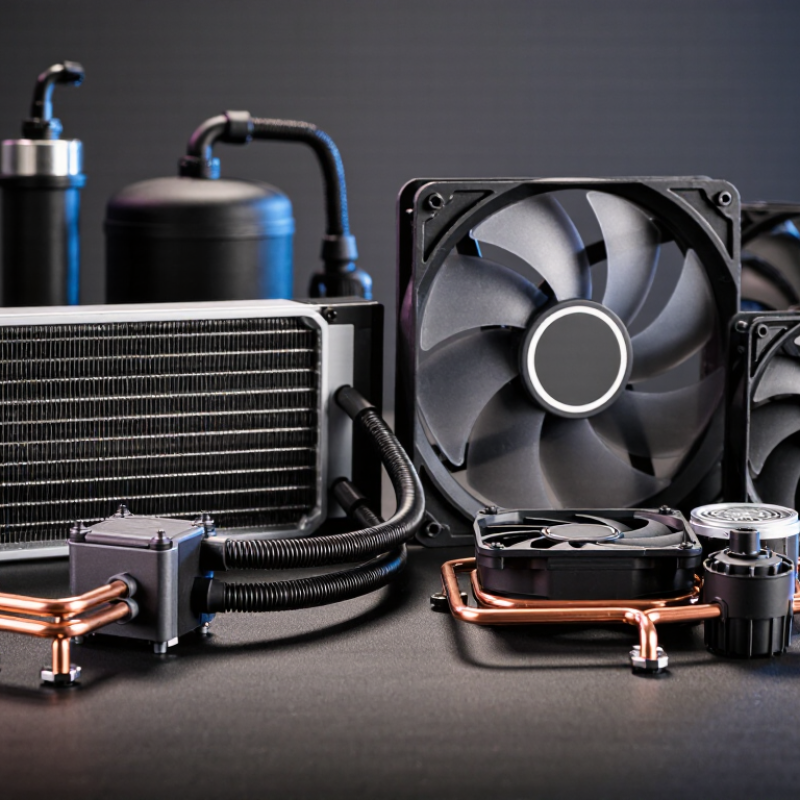
A reliable CPU liquid cooler supplier in China is defined by repeatable engineering, not attractive samples. During factory evaluations, buyers should inspect pump assembly, cold-plate machining, tubing joints, and coolant filling procedures. Small details matter. A clean test bench matters too.
MarketsandMarkets projects the data-center liquid-cooling market to grow from about USD 4.7 billion in 2024 to USD 12.5 billion by 2029. This growth increases supplier pressure, especially on quality consistency. A dependable supplier should provide thermal resistance results, pump-life testing, leak checks, and noise measurements under stated conditions. ISO 9001 systems help, but certificates alone prove little. Ask for recent batch records and third-party test reports.
Reliability also depends on communication after production. The supplier should confirm radiator dimensions, socket compatibility, fan curves, packaging strength, and replacement procedures before mass production. Samples should survive extended operation, transport vibration, and repeated temperature changes. Some suppliers offer excellent prototypes but weaker production control. That gap deserves attention. I would request inspection data from several consecutive batches, not one successful sample. Clear corrective-action records are valuable, even when they reveal previous mistakes. No factory is perfect. Honest reporting is often more trustworthy than polished claims.
This procurement scoring model gives the greatest weight to cooling performance and quality control, followed by manufacturing capability, delivery reliability, warranty support, and compliance documentation. Buyers can use these measurable criteria when comparing Chinese CPU liquid cooler suppliers without relying on brand reputation alone.
China remains a major production base for CPU liquid coolers, but capabilities differ sharply by region. According to the 2024 China Manufacturing PMI data from the National Bureau of Statistics, equipment and component production remained active despite uneven export demand. The Pearl River Delta supports fast tooling, CNC machining, and compact assembly lines. Shenzhen and Dongguan suppliers often manage rapid engineering changes. Their strength is speed. Quality consistency can vary.
The Yangtze River Delta offers broader industrial depth. Jiangsu and Zhejiang provide cold-plate machining, copper processing, pump components, and automated testing. The 2024 Liquid Cooling Market report by MarketsandMarkets projects strong global growth through 2029, driven by rising thermal loads in computing systems. This demand is encouraging suppliers to invest in leak testing, vibration testing, and thermal resistance measurement. Some factories now record coolant flow, pressure, and noise data for every production batch.
Northern manufacturing areas contribute metal forming, motor parts, and logistics capacity. However, regional integration is not always smooth. A supplier may use a precision cold plate from one province, a pump motor from another, and final assembly elsewhere. That structure can reduce costs, but it complicates traceability. UL Solutions and IEC-based testing practices are increasingly referenced by export-oriented manufacturers, although implementation differs among factories. Buyers should inspect production records, sampling methods, failure analysis, and warranty data, not only factory size. A polished showroom proves little. On-site evidence matters more.
| Manufacturing Region | Major Industrial Clusters | Core Manufacturing Capabilities | Typical CPU Cooler Deliverables | Common Quality and Testing Practices | Best-Fit Buyer Requirements |
|---|---|---|---|---|---|
| Guangdong Province | Shenzhen, Dongguan, Huizhou, Foshan and the wider Pearl River Delta | High-volume electronics assembly, injection molding, CNC machining, copper and aluminum processing, fan assembly, pump integration and cable production | 240 mm, 280 mm and 360 mm all-in-one coolers; customized radiator, pump housing, fan and lighting assemblies | Leak testing, pump operation testing, fan speed verification, electrical safety checks, noise testing and production-line sampling | OEM/ODM programs, fast product iteration, customized appearance and medium-to-large production volumes |
| Jiangsu Province | Suzhou, Kunshan, Wuxi, Changzhou and the Yangtze River Delta manufacturing belt | Precision metalworking, cold-plate machining, stamping, brazing, die casting, automated assembly and industrial quality control | Copper cold plates, aluminum radiators, precision brackets, mounting kits and complete liquid-cooling assemblies | Dimensional inspection, thermal performance testing, pressure and leak testing, material traceability and process capability monitoring | Buyers requiring tight tolerances, stable repeatability, engineering documentation and structured quality systems |
| Zhejiang Province | Ningbo, Hangzhou, Jiaxing, Taizhou and nearby hardware and plastics clusters | Plastic injection molding, die casting, metal stamping, hardware production, tooling development and electromechanical assembly | Pump covers, fan frames, reservoirs, mounting hardware, tubing fittings and cost-optimized cooler components | Mold qualification, visual inspection, dimensional checks, assembly testing and batch-based reliability sampling | Private-label products, cost-sensitive programs, customized plastic parts and flexible component sourcing |
| Shanghai and Northern Yangtze River Delta | Shanghai, Nantong, Taicang and surrounding industrial areas | Advanced mechanical engineering, thermal design, automation integration, laboratory testing and international supply-chain coordination | Engineering-led liquid-cooling platforms, customized cold plates, prototype units and compliance-oriented assemblies | Thermal resistance evaluation, temperature cycling, vibration testing, endurance testing and engineering validation reports | Industrial computers, workstations, servers and buyers needing documented product validation |
| Fujian Province | Xiamen, Quanzhou and surrounding electronics and hardware manufacturing areas | Electronics assembly, metal and plastic parts, cable processing, packaging and export-oriented manufacturing | Entry-level and mid-range AIO coolers, replacement assemblies, mounting accessories and customized packaging | Incoming material inspection, functional assembly checks, visual inspection and shipment sampling | Retail packaging, moderate order volumes, replacement parts and straightforward private-label projects |
| Chongqing and Central China | Chongqing, Wuhan, Zhengzhou and other inland electronics and machinery centers | Automated production, machinery processing, plastics, electrical assembly and cost-efficient inland logistics | Selected cooler components, mounting parts, subassemblies and volume-oriented production programs | Assembly-line inspection, functional testing, sampling inspection and supplier process audits | Large-volume procurement, cost control and supply-chain diversification away from coastal production bases |
CPU liquid coolers generally fall into three practical types: all-in-one, custom-loop, and direct-die systems.
All-in-one coolers combine a pump, radiator, tubing, and cold plate in a sealed unit. They suit gaming desktops, office workstations, and small production systems. Installation is relatively quick. However, pump noise and long-term serviceability still require attention.
Custom-loop coolers use separate reservoirs, pumps, radiators, and fittings. They support high-load workstations, simulation machines, and enthusiast computers with adjustable thermal targets.
Direct-die cooling removes the processor’s integrated heat spreader from the cooling path. It can reduce thermal resistance, but installation is complex and errors may damage hardware. This type needs trained technicians, careful pressure control, and strict maintenance records.
The application trend is expanding beyond personal computers. MarketsandMarkets estimates the global liquid cooling market will grow from about USD 4.7 billion in 2023 to USD 12.0 billion by 2028, representing a 20.6% compound annual growth rate. The report links this growth to rising computing density and artificial intelligence workloads.
For supplier evaluation, radiator thickness alone is not enough. Buyers should compare pump reliability, coolant compatibility, acoustic output, warranty terms, and replacement access. My practical concern is often overlooked: a cooler may perform well in a short benchmark, yet lose efficiency in a dusty room after months of use.
Choosing a China-based CPU liquid cooler supplier requires more than comparing prices.
Inspect the cold plate, pump housing, tubing, and radiator fins. Copper contact plates should appear smooth and evenly machined. Ask for thermal testing at several heat loads, not only peak performance. Request evidence from production batches, including leak tests and pump noise measurements. Small details matter.
Certifications can reveal process discipline, but certificates need verification. Check whether documents match the exact model and factory location. Relevant safety and electromagnetic compatibility approvals may support market access. Quality systems, such as audited manufacturing procedures, also deserve attention. Still, paperwork is not performance. I would request recent test records and, when possible, independent sample testing. A polished certificate cannot fix weak assembly.
Tips:
Ask for a sample before placing a large order. Measure socket compatibility, mounting pressure, hose length, and radiator clearance. Discuss customization early, including logos, packaging, fan curves, connector types, and coolant colors. Confirm minimum order quantities, tooling charges, sample timelines, and warranty handling in writing. Keep one untouched sample for future comparison. Suppliers may promise broad customization, yet some options increase failure risks or delay production. That deserves a second conversation. Reliability is built through repeatable checks, clear records, and honest limits.
China’s leading CPU liquid cooler suppliers should be judged beyond factory price. MarketsandMarkets projects the data-center liquid-cooling market to grow from about USD 4.6 billion in 2023 to USD 12.3 billion by 2028. This wider trend increases component demand, but it does not guarantee desktop cooler quality. Request factory audit records, production capacity, and recent thermal test data. A polished catalog is not enough.
Indicative export pricing often reaches USD 20–45 for a 240 mm cooler and USD 28–65 for a 360 mm model at volume. Actual quotes depend on pump design, radiator thickness, lighting, packaging, and order quantity. Confirm whether pricing includes tooling, testing, spare parts, and export packaging. Get it in writing. A cheaper quote can be the wrong quote. Sample orders should test cold starts, pump noise, mounting pressure, and leakage after transport vibration.
After-sales terms deserve equal attention. Ask for a clear warranty period, replacement procedure, RMA response time, and local spare-parts availability. Request records for DOA rates and recurring pump failures. Suppliers should provide batch traceability and a documented leak-test process. UL, CE, RoHS, and other market requirements must match the destination country. MarketsandMarkets’ growth data is useful, but it covers a broader cooling sector, not every desktop product. That distinction matters. Noise matters too. Some purchasing teams overlook it until customer complaints appear.