How to Choose Carbon Film Resistors for Your Needs?

Choosing a resistor is rarely about price alone. It is about stability, heat, signal behavior, and long service life. A Carbon Film Reaistor can suit general-purpose circuits, audio equipment, test instruments, and educational projects. However, its performance depends on tolerance, resistance value, rated power, temperature coefficient, and operating environment.

Industry research supports this careful approach. MarketsandMarkets’ resistor market analysis identifies industrial electronics, automotive systems, and communications equipment as major demand areas. These applications increasingly require reliable passive components under vibration, heat, and electrical stress. Mordor Intelligence’s resistor market coverage also highlights miniaturization and higher circuit reliability as continuing industry trends. These reports do not make every carbon film resistor a universal solution. They show why specifications matter.

IEC 60115-1 provides important requirements for fixed resistors, including electrical performance and reliability testing. In practical selection, check the circuit’s highest voltage and expected continuous power first. A 0.25-watt resistor may feel adequate on paper, yet it can become dangerously hot inside a poorly ventilated enclosure. Leave a sensible safety margin. For example, a resistor dissipating 0.12 watts may perform more reliably when rated for 0.25 watts or more. Also compare tolerance with the circuit’s accuracy requirements. Five percent tolerance may work for an indicator LED, but precision measurement may require one percent or better. This guide combines standards, manufacturer specifications, and real workshop considerations. Some recommendations remain context-dependent. That is worth remembering.
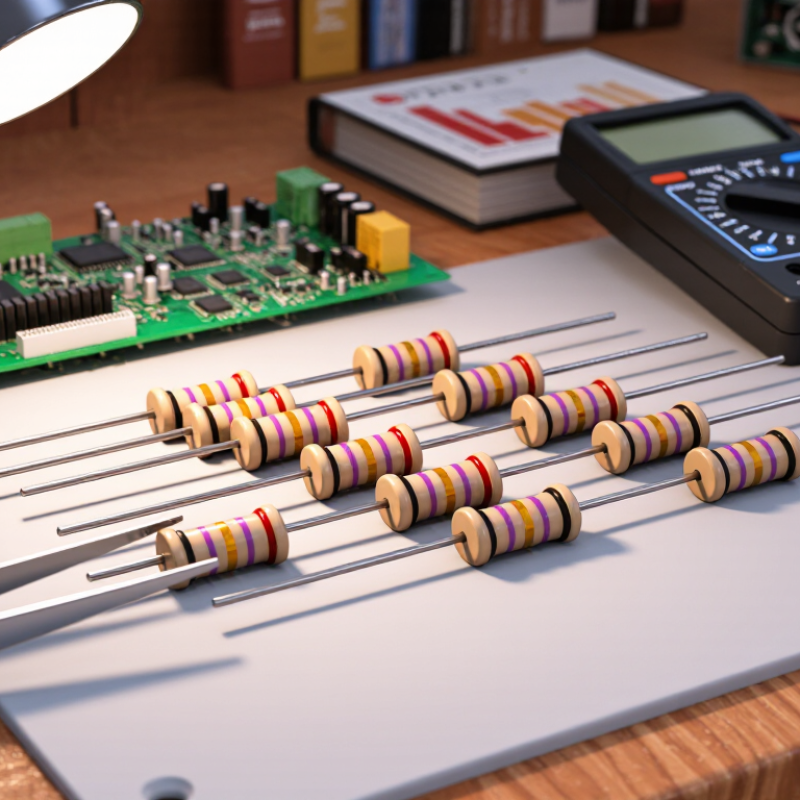
How to Choose Carbon Film Resistors for Your Needs?

Define the Electrical Requirements for Your Carbon Film Resistor

Before choosing a carbon film resistor, define the circuit’s electrical requirements clearly. Start with the nominal resistance, measured in ohms, and identify the acceptable tolerance. A 1 kΩ resistor with 5% tolerance may suit a simple indicator circuit. It may not suit a precision sensing stage. Write the resistance range, not only one preferred value. This exposes hidden design assumptions.

Power rating needs careful attention. Calculate P = I²R or P = V²/R under normal operation. Then examine startup surges, switching pulses, and possible fault conditions. A resistor operating near its rated power can become hot and drift. I usually select a meaningful safety margin, often keeping continuous loading below half the rating. That is practical, not universal. Verify the actual thermal conditions.

Voltage rating also matters, especially in high-resistance circuits. Check the resistor’s maximum working voltage and pulse capability in its technical datasheet. Temperature coefficient should match the circuit’s stability needs. Carbon film resistors can change resistance with temperature, aging, and electrical stress. Consider noise too, because sensitive amplifier inputs may reveal it. I once approved a value from resistance and wattage alone, then found excessive drift during warm-up. The calculation was correct. The requirement definition was incomplete. Record ambient temperature, humidity, expected lifetime, and measurement accuracy before final selection. Test a few samples under realistic load, because laboratory room temperature can hide a weak decision.

Compare Resistance Value, Tolerance, and Temperature Coefficient

How to Choose Carbon Film Resistors for Your Needs?

Selecting a carbon film resistor starts with the resistance value. Match it to the circuit’s required current and voltage, not just the nearest available number. A 10 kΩ resistor may suit a sensor input, while a lower value could load that signal and distort readings. I usually check the circuit at its highest supply voltage first. Small oversights can become warm, visible failures.

Tolerance describes the resistor’s possible production error. A 5% resistor rated at 10 kΩ may measure between 9.5 kΩ and 10.5 kΩ. For basic indicator circuits, that range may be acceptable. Precision timing, measurement, and bias networks often need 1% tolerance or tighter. Tolerance is not temperature drift. They are separate specifications. That distinction is easy to miss.

The temperature coefficient shows how resistance changes with temperature, usually in parts per million per degree Celsius. Suppose a 10 kΩ resistor has a 200 ppm/°C coefficient. A 50°C rise can change its value by roughly 1%, before its original tolerance is considered. Check the expected temperature near hot regulators, power resistors, or enclosed boards. I once selected by tolerance alone, and the circuit shifted after warm-up. The datasheet looked fine. My assumption was not. Measure a sample at room temperature and again after realistic operation when stability matters.

Select the Appropriate Power Rating and Operating Voltage

Choosing a carbon film resistor starts with its power rating and operating voltage. These two values protect the resistor from overheating and electrical breakdown.

Calculate expected power with P = V²/R or P = I²R.

Then choose a resistor rated higher than the calculated result. A 0.25-watt part may survive briefly at 0.2 watts, but continuous operation leaves little thermal margin.

Operating voltage needs separate attention. A resistor can meet its power rating and still fail under excessive voltage. Check the datasheet’s maximum working voltage, especially in high-voltage circuits or circuits with fast switching.

I usually allow extra margin for ambient heat, enclosed spaces, and supply variation. In bench repairs, I have seen small resistors discolor because their voltage stress was ignored. The calculation looked acceptable, but the real circuit was less forgiving. That mistake is easy to repeat.

Tips: Measure the highest expected voltage, not only the nominal value. Compare both power and working-voltage limits.

For example, split a high voltage across two resistors in series when one part is close to its limit. Keep each resistor below about half its rated power in warm environments. Confirm temperature derating in the datasheet.

Also consider pulses; a resistor rated for steady power may not tolerate repeated surges. Carbon film resistors are practical for general circuits, but I would reconsider them where long-term precision or frequent voltage spikes matter.

Evaluate Noise, Stability, Size, and Environmental Conditions

How to Choose Carbon Film Resistors for Your Needs?

When selecting a carbon film resistor, start with noise and stability rather than resistance value alone. Carbon film parts can produce more excess noise than metal film types, especially in sensitive audio or measurement circuits. Check the specified noise level, tolerance, and temperature coefficient. A low temperature coefficient helps resistance remain predictable as the enclosure warms from 25°C to 60°C. I have seen a circuit pass bench testing, then shift noticeably after an hour of operation.

Size also affects reliability. A larger body usually handles heat better, but it may not fit a compact control board. Compare rated power with actual dissipation, then apply a safety margin. Do not run a 0.25-watt resistor continuously near its limit. That choice may work briefly. It may age faster. In pulse circuits, inspect overload and voltage ratings, not only wattage.

Tips: List the real conditions first: temperature range, humidity, vibration, dust, and nearby heat sources. For outdoor or damp equipment, verify suitable protection and insulation requirements. Keep leads short when noise pickup matters, but leave enough spacing for inspection and repair. Check the datasheet at the intended operating temperature. Room-temperature values can mislead. When uncertain, test several samples under heat and load. A small test can reveal a costly assumption.

Verify Availability, Reliability, and Compatibility Before Purchase

How to Choose Carbon Film Resistors for Your Needs?

Verify availability before comparing price or tolerance. The 2024 ECIA Electronic Component Supply Chain Confidence Index showed that component availability remained a major purchasing concern, despite supply conditions improving. A resistor listed online is not always ready to ship. Check stock quantity, factory lead time, minimum order quantity, and last-time-buy notices. Request a dated availability statement. It may prevent a redesign six months later.

Reliability starts with operating margin. Select a power rating at least twice the calculated dissipation when space and cost allow. A 0.25-watt resistor carrying 0.18 watt may work, but it leaves little thermal headroom. IEC 60115-1 provides the framework for fixed resistor performance, including resistance tolerance and environmental testing. Check temperature coefficient, pulse capability, insulation voltage, and moisture resistance against the actual circuit. Carbon film parts can suit general signal and bias networks, but they may be less suitable for precision measurement or repeated surge conditions. Compatibility also includes lead spacing and body size. Measure the board, not just the drawing.

Do not trust one data sheet alone. Compare supplier documentation, test conditions, and revision dates. I still find mismatched values in purchasing lists. That is a useful warning. Confirm the resistance value after storage, soldering, and temperature exposure when reliability matters. Sources such as IEC 60115-1 and the ECIA supply-chain index support disciplined selection, but neither replaces testing the chosen part in its real operating environment.

Go to Top